
Talk To Our Experts
905-305-9955[Blogs]
Conference Table Options Guide for Toronto, Markham and Oakville Workplaces
Sep 4 2026

Choosing a conference table is one of those decisions that seems simple until you are standing in an empty boardroom with a tape measure in one hand and a supplier catalog in the other.
The right conference table shapes how your team collaborates, how clients perceive your business, and how well your meeting room technology actually works. For businesses across Toronto, Markham and Oakville, getting this decision right means balancing room dimensions, seating capacity, material quality and budget.
This guide breaks down conference table shapes, sizes, materials and technology considerations so you can make a confident, informed purchase.
Why Choosing the Right Conference Table is Important
A conference table often becomes the visual anchor of your office. It is where clients form first impressions, where leadership teams make decisions, and where employees spend hours collaborating on projects.
A poorly sized or outdated table can undercut all of that, even in an otherwise well-designed workplace.
A table selection like this typically comes up alongside a broader project, and businesses working through a full layout for office floor plan often plan their boardroom furniture and their overall space at the same time. Businesses in professional services, financial services, law and accounting rely on their boardroom to project credibility during client meetings.
Manufacturing, construction and engineering firms often use this furniture for project reviews involving drawings, samples and multiple stakeholders. Healthcare organizations, including medical clinics and dental offices, need meeting spaces for staff coordination. Educational institutions use meeting tables for faculty sessions, board meetings and parent consultations, and each of these use cases calls for a slightly different approach to shape, size and finish.
The Office Shop has spent nearly three decades helping organizations across Ontario select furniture that matches how their teams actually work, not just how a showroom display looks. Our office furniture consulting team starts every project with a conversation about room dimensions, meeting frequency and technology needs before recommending a single product.
Need help figuring out what conference table setup makes sense for your meeting culture? Contact The Office Shop for a consultation and let our team walk through your options with you.

Conference Table Shapes and What Each One Communicates
Shape is usually the first decision businesses make, and it affects seating capacity, sightlines and the overall tone of the room. Here is how the most common conference table shapes compare.
Rectangular
Rectangular tables remain the most popular choice for traditional boardrooms because they maximize seating along the length of the table and fit efficiently into most rectangular rooms.
They also reinforce a clear meeting structure, with leadership typically seated at the head and guests along the sides. Straight edges allow tighter spacing, generally around 24 to 30 inches per person, which makes this shape a practical option for businesses seating larger groups without expanding the room’s footprint.
The tradeoff is that rectangular designs can create awkward sightlines for people seated at the far ends, particularly during video calls where camera placement matters. For law firms, accounting practices and other professional services businesses hosting formal client meetings, this formality is often an asset rather than a drawback.
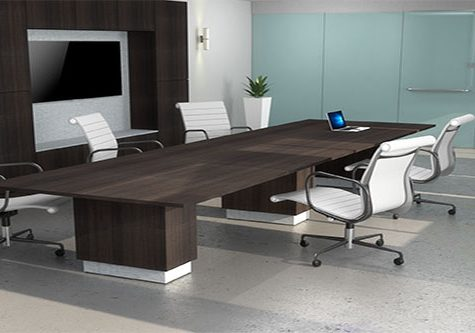
The Office Shop carries various rectangular options including the IOF Boardroom Table, built for organizations that need a classic, quality conference table.
Racetrack and Boat-Shaped
Racetrack tables combine the seating efficiency of a rectangle with softened, rounded ends. This shape removes the awkward corner seating positions found in rectangular designs and improves circulation, which matters in smaller rooms where people need to move past seated colleagues.
Boat-shaped versions take this further with a subtle curve along the long sides, improving sightlines for video conferencing since every seat has a clearer view of the screen and camera.
Both shapes work well for organizations hosting a mix of internal team meetings and client presentations, since they feel slightly less rigid than a straight rectangle while still supporting a reasonably large group.
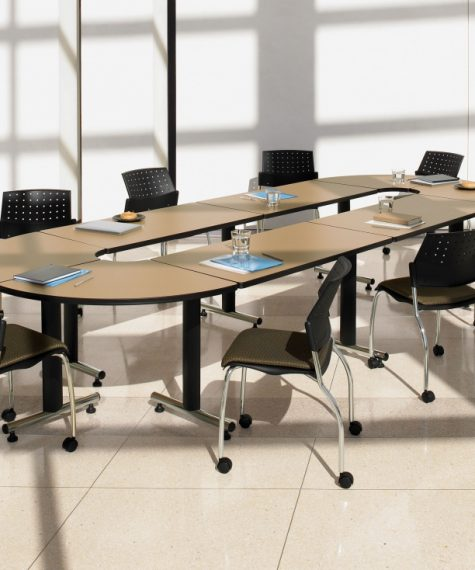
Consider the Global Connectables Modular Tables for a versatile racetrack option.
Round
Round tables encourage equal participation because there is no head of the table and no dominant seating position. This makes them a strong choice for collaborative teams, creative agencies, startups and coworking operators who want meetings to feel less hierarchical. The tradeoff is capacity.
Round designs typically cap out around six to eight seats before conversation becomes difficult to sustain, and larger versions waste usable floor space in the corners of a square or rectangular room.
Square
Square tables suit smaller meeting spaces and huddle rooms where four to six people gather for quick discussions.
They have become popular in modern offices with multiple smaller meeting rooms instead of one large boardroom, reflecting how hybrid teams often prefer several flexible spaces over a single formal one.
Modular Conference Tables
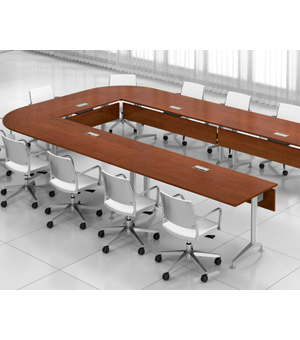
Modular systems allow individual sections to be reconfigured into different shapes and sizes depending on the meeting. This flexibility makes modular conference tables a strong fit for training rooms, classrooms and multipurpose spaces that need to switch between one large boardroom configuration and several smaller breakout groupings.
The Office Shop carries modular options including the Krug Revo modular boardroom table and the Krug V2 modular boardroom table, both built for organizations that need adaptability without sacrificing a polished appearance.
Krug Revo Modular Boardroom Table
Krug V2 modular boardroom table
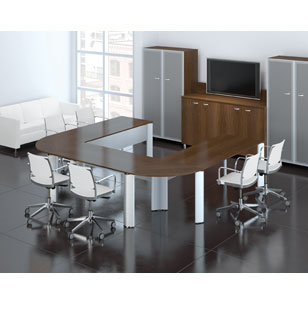
Not sure which shape fits your meeting room’s proportions? Reach out to The Office Shop and our design team can review your floor plan before you commit to a size or shape.
How to Size a Conference Table Correctly
Sizing mistakes are among the most common and costly errors businesses make when purchasing a conference table.
A table that is too large leaves no room for chairs to push back, blocks doorways and makes the space feel cramped. One that is too small leaves awkward gaps around the perimeter and can make a boardroom feel underfurnished.
Start by measuring your room and subtracting clearance space on all sides. Industry standards call for a minimum of 36 inches behind each seated chair, with 42 inches preferred where space allows, so people can push back and stand without bumping into a wall or credenza.
A helpful rule many designers use is to subtract roughly 8 feet from one room dimension and 7 feet from the other to estimate the maximum practical footprint.
Once you know that footprint, calculate seating capacity using an allowance of approximately 24 to 30 inches of length per person. A 10-person table generally needs to be at least 10 feet long, while an 8-foot table comfortably seats 6 to 8 people. Common configurations include:
- Small (6 to 8 feet): ideal for 4 to 8 people, well suited to smaller offices, huddle rooms or breakout spaces
- Medium (10 to 12 feet): the most common size for mid-sized businesses, typically seating 8 to 12 people
- Large (14 feet or more): suited to executive boardrooms and larger organizations that regularly host 12 or more attendees
Height also matters, particularly if your business is investing in ergonomic seating. Most conference tables sit between 28 and 30 inches high, though standing-height versions are becoming more common in offices that want to encourage shorter, more focused meetings.
If your organization is prioritizing employee comfort, it is worth reviewing table height alongside your broader approach to ergonomic solutions, since a mismatch undermines the benefit of ergonomic seating.
Unsure how many people your available boardroom space can comfortably seat? The Office Shop’s space planning team can measure your room and recommend the right dimensions before you buy.

Materials and Finishes
Material choice affects durability, maintenance and the overall tone of your meeting space. Businesses generally choose between a handful of common materials.
Wood veneer remains popular for executive boardrooms because it projects a traditional, established feel. Veneer surfaces come in a wide range of finishes and hold up well with regular care, though they need more careful handling than laminate to avoid scratches and water marks.
Laminate offers a similar range of finishes at a lower price point and stands up well to daily wear, making it a practical choice for training rooms and busy spaces used by multiple teams.
Glass tops create a modern, open feel and work well in smaller meeting rooms where a heavier material might make the space feel closed in, though they require more frequent cleaning. Metal-framed designs, often paired with laminate or veneer tops, suit organizations with an industrial or contemporary aesthetic, including technology companies, coworking spaces and creative agencies.
Several of these finishes come from Canadian manufacturers, a theme we explore further in our guide to Canadian commercial furniture brands. The Office Shop’s boardroom table collection spans these material categories.
Trying to match a conference table finish to your existing office furniture? The Office Shop can pull samples so you can see exactly how a new piece will look alongside your current setup.
Technology and Power Integration
Meeting room technology has become a standard expectation rather than a luxury add-on. Businesses hosting hybrid meetings, client video calls or presentations need a table that supports laptops, monitors, video conferencing equipment and charging needs without a tangle of visible cables.
This shift mirrors what we cover in our piece on smart office furniture, where tech-enabled, adaptable furniture is reshaping Canadian workplaces. Built-in power and data modules let employees charge devices directly at the table, while integrated cable management keeps cords out of sight and away from foot traffic.
Some models include recessed technology troughs that run through the legs to the floor, keeping cabling fully hidden. For organizations that regularly host video calls, boat-shaped and racetrack tables tend to perform better than long rectangular ones because every seat has a clearer line of sight to the screen and camera.
The Krug Nuvo boardroom table is a strong example of technology-forward design, built with integrated connectivity and cable management so meetings connect seamlessly with conferencing technology without exposed wiring disrupting the room’s appearance.
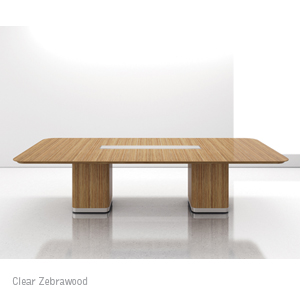
If your business is planning a hybrid meeting room, it is worth reviewing your conference table and your broader space planning and design strategy together, since screen placement, camera angles and seating arrangement all depend on how the table sits in the room.
Planning a hybrid meeting room and not sure how to position your screen, camera and table together? Talk to The Office Shop’s design team about a layout that works for both in-person and remote attendees.
Conference Tables for Toronto, Markham and Oakville Workplaces
Businesses across the Greater Toronto Area face similar space constraints, but local market conditions shape how organizations approach their boardroom furniture. In Toronto, many businesses operate in older commercial buildings or shared office towers where meeting room dimensions are fixed, which makes accurate measurement and a properly sized table especially important.
Downtown offices and coworking operators often prioritize flexible, modular options that can be reconfigured for different group sizes throughout the day, a strategy also discussed in our roundup of Toronto workspace furniture ideas.
In Markham, where The Office Shop has been headquartered since 1996, we work with a wide mix of corporate offices, technology companies and professional services firms furnishing new headquarters or expanding existing space. Markham businesses frequently combine a larger primary boardroom with several smaller huddle rooms, which often means pairing a medium or large rectangular table in the main space with square or round tables elsewhere.
Oakville businesses tend to favor a more polished, client-facing aesthetic, particularly among the professional services and financial firms concentrated in the area. Wood veneer and glass-top tables are popular choices for Oakville boardrooms that regularly host client meetings.
The Office Shop supports conference table selection, delivery and installation for businesses throughout the GTA and across Ontario, including:
- Toronto
- Markham
- Oakville
- Vaughan
- Richmond Hill
- North York
- Scarborough
- Etobicoke
- Mississauga
- Brampton
- Burlington
- Hamilton
- Milton
- Ajax
- Pickering
- Whitby
- Oshawa
- Aurora
- Newmarket
- Guelph
- Cambridge
- Kitchener/Waterloo
- London
- Barrie
- St. Catharines
- Woodbridge
- Ottawa
- Sudbury
- Bolton
Furnishing a boardroom in one of these cities and want to see conference table options in person? Book a showroom visit or consultation with The Office Shop to see finishes and configurations before you decide.

Choosing a Conference Table by Industry
Different industries put different demands on a conference table, so it helps to think about your specific use case rather than buying on appearance alone.
Professional services firms, including law offices and accounting practices, typically want something that projects authority and stability for client meetings, and a rectangular or boat-shaped table in a wood veneer finish tends to suit this need well.
Construction, engineering and architecture firms often need enough surface area for drawings, blueprints or physical samples alongside laptops, which usually points toward a larger rectangular or racetrack option with a durable, easy-to-clean surface.
Healthcare organizations, including medical clinics and dental offices, tend to prioritize practical, easy-to-maintain furniture for staff meetings, since these rooms often double as training or administrative spaces.
Educational institutions frequently need tables for faculty rooms and board meetings, and modular options offer helpful flexibility when a room serves multiple purposes. Technology companies, startups and coworking operators often lean toward round or modular designs that support a collaborative meeting culture.
The Office Shop supports furniture selection across education institutions and healthcare environments, along with broader commercial office furniture projects for corporate clients across Ontario.
Not sure what configuration fits your industry’s meeting style? The Office Shop’s consultants have worked across healthcare, education, professional services and corporate offices and can recommend options based on how your team actually meets.
→ Get in touch with our team for a free consultation.
Budgeting for a Conference Table
Pricing varies significantly based on size, material and technology features. A basic laminate table in a small size can start in the low hundreds of dollars, while a large custom veneer boardroom table with integrated power and data can run into the thousands.
Businesses should budget for the table itself along with matching chairs, delivery and professional installation, since improperly assembled tables can develop wobble or alignment issues over time.
It is worth thinking about total cost of ownership rather than just the upfront price. A well-built table from a reputable manufacturer will typically outlast several cycles of cheaper furniture, which reduces long-term replacement costs.
Businesses planning a larger office project, including a full furniture refresh or relocation, often find it more cost-effective to bundle this purchase with other furniture needs rather than buying pieces individually over time.
If your business is working through a broader office move alongside a new conference table purchase, our moving and relocation management service coordinates delivery and installation timing with your move schedule, so your new boardroom is ready when your team arrives.
Trying to figure out a realistic budget for your boardroom furniture project? Contact The Office Shop for a quote based on your room size and the finishes you have in mind.
New, Used and Rental Options
Not every business needs to buy a brand-new conference table outright. Organizations testing a new office layout, working on a project timeline, or operating on a tighter budget often benefit from exploring used or rental options.
A used table in good condition can offer significant savings while still providing a professional appearance, which makes this a practical choice for startups and growing businesses furnishing a boardroom without a large upfront investment, an approach we cover in more detail in our guide to used office furniture in Toronto and Markham.
Rental furniture works well for project offices, temporary workspaces and short-term leases where a business does not want to commit to a permanent purchase, a common need among construction firms managing a temporary site office or businesses navigating a transition period during a relocation.
The Office Shop’s rentals, used products and consultations service gives businesses access to quality conference tables and other office furniture without the commitment of a full purchase, and our team can help you decide what makes the most sense for your situation.
Weighing whether to buy new or explore used and rental conference table options? Reach out to The Office Shop and we can walk through the tradeoffs based on your budget and timeline.

Working with The Office Shop
Selecting a conference table is rarely a standalone decision. It usually connects to a larger project: furnishing a new office, updating an existing boardroom, or planning a full office move. The Office Shop has supported businesses across Ontario since 1996, offering complete workplace solutions that go beyond simply selling furniture.
Our team begins with an in-person or virtual consultation to understand your room dimensions, meeting frequency, technology needs and budget.
From there, we provide product recommendations from more than 60 manufacturers, including Global Furniture Group and Group Lacasse, so you have access to a wide range of shapes, sizes and finishes rather than a limited catalog.
Once you have made a selection, our team manages delivery and professional installation and reconfiguration, ensuring the table is assembled correctly and positioned to support your room’s technology and traffic flow.
For businesses planning a larger workspace project, our space planning and design team can develop a full boardroom layout, including CAD drawings that show exactly how your new conference table will fit alongside seating, storage and audiovisual equipment.
Businesses that need dedicated IT and data cabling support for a new meeting room can also work with our partners at CrownTech for space planning that covers both furniture and technology infrastructure.
Ready to move forward with a conference table for your Toronto, Markham or Oakville office? Contact The Office Shop today to schedule a consultation and get expert guidance from a team that has been furnishing Ontario workplaces for nearly 30 years.
Final Thoughts on Choosing the Right Conference Table
Selecting a conference table involves more decisions than most businesses expect, covering shape, size, material, technology integration and budget.
Getting these details right creates a meeting space that supports how your team actually works, rather than one that looks good but functions poorly. Businesses across Toronto, Markham, Oakville and the wider GTA benefit from working with a local furniture partner who understands both the sizing requirements and the design expectations of their industry.
The Office Shop combines nearly 30 years of experience with access to more than 60 manufacturers, giving businesses confidence that their new table will fit their room, their team and their budget from day one.
→ Get in touch with our team for a free consultation.
Conference Table Frequently Asked Questions
What size conference table do I need for a 10-person boardroom?
As a general guideline, allow 24 to 30 inches of table length per person. A 10-person conference table typically needs to be at least 10 feet long, though the exact size also depends on the shape you choose and how much clearance space is available around the table.
What is the difference between a conference table and a boardroom table?
The terms are often used interchangeably, but boardroom tables are typically larger, more formal and designed for executive-level meetings, while conference tables cover a broader range of sizes and styles used for everyday team meetings, client presentations and training sessions.
How much clearance space does a conference table need around it?
Most designers recommend a minimum of 36 inches of clearance behind each seated chair, with 42 inches preferred where the room allows, so people can push back and move around the table comfortably.
Which conference table shape is best for video conferencing?
Boat-shaped and racetrack tables generally perform better for video conferencing than long rectangular tables, since their curved sides improve sightlines and keep every seat within a clearer view of the screen and camera.
Should I choose a wood veneer or laminate conference table?
Wood veneer offers a more traditional, executive appearance and holds up well with careful maintenance, while laminate is more budget-friendly and better suited to high-traffic training rooms or spaces used by multiple teams throughout the day.
Can conference tables be reconfigured for different room sizes?
Yes. Modular conference tables allow individual sections to be rearranged into different shapes and sizes, which makes them a practical option for training rooms, classrooms and multipurpose spaces that need to switch configurations regularly.
Is it worth buying a used conference table?
A used conference table in good condition can offer meaningful savings while still providing a professional appearance, making it a practical option for startups, growing businesses or organizations working with a tighter budget or shorter timeline.
Does The Office Shop deliver and install conference tables?
Yes. The Office Shop provides delivery and professional installation for every conference table we sell, along with space planning support to ensure your new table fits your room and works well with your existing technology and furniture.
Get A Free Office Furniture Consultation

Let's Talk with Our Experts
1-877-305-9955  or
or

Category
Recent Posts
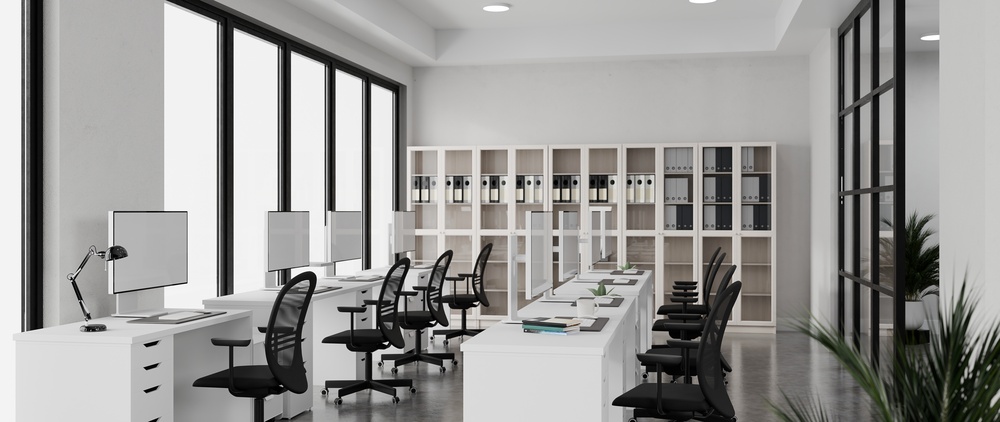
Office Desks With Drawers: How The Office Shop Plans Storage Into Every Workstation
Design Services, Brochures & Guides
Oct 21 2026 

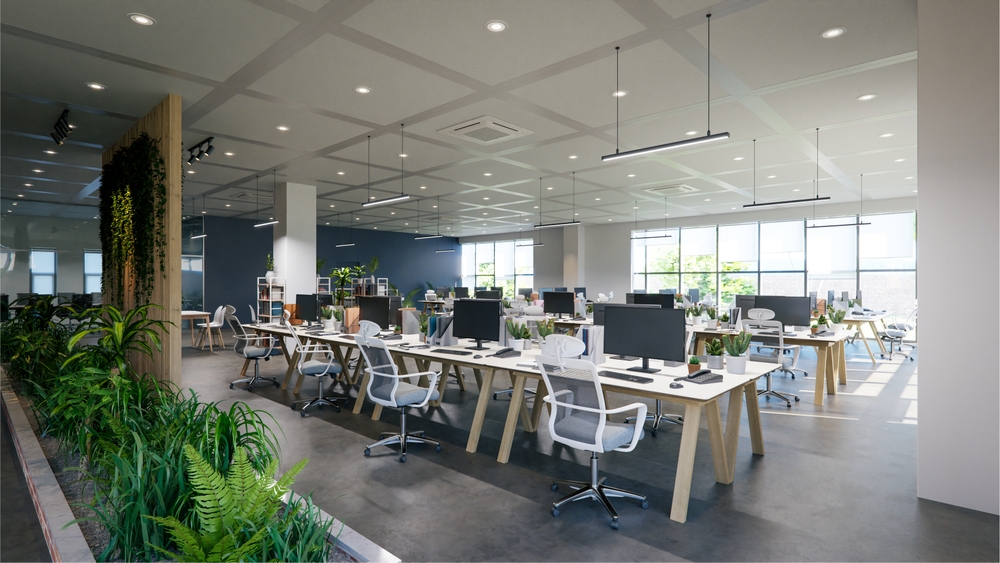
Coworking Space Furniture: How The Office Shop Helps Operators Build Flexible, Durable Spaces
Design Services, Brochures & Guides
Oct 9 2026
Office Furniture Reconfiguration: How The Office Shop Helps You Reuse What You Already Own
Design Services, Brochures & Guides
Oct 2 2026
[Find A Consultant]
We service all across Canada


Office Furniture Mississauga Ontario 


Office Furniture Brampton Ontario


Office Furniture Markham Ontario

Office Furniture North York Ontario
Office Furniture Hamilton Ontario

Office Furniture Scarborough Ontario

Office Furniture Etobicoke Ontario
Office Furniture Pickering Ontario

Office Furniture Ajax Ontario
Office Furniture Milton Ontario
Office Furniture Whitby Ontario
Office Furniture Richmond Hill Ontario
Office Furniture Oshawa Ontario
Aurora Office Furniture Ontario

Office Furniture Guelph Ontario

Office Furniture Cambridge Ontario

Office Furniture St. Catharines Ontario

Office Furniture Woodbridge Ontario
[FREE consultation]
Complete for a FREE consultation
with a furniture design specialist!
Links
Contact Us
 Call Us
905-305-9955
 Location
366 Denison St, Markham, ON L3R 1B9, Canada
Request Our Lookbook
SEND REQUEST
Sitemap | Copyright @ 2025 The Office Shop
Digital marketing and CRM solutions, engineered by Consultus Digital